Reference Image vs Text Prompt in AI Home Design: Making the Right Choice
Choosing Between Reference Images and Text Prompts
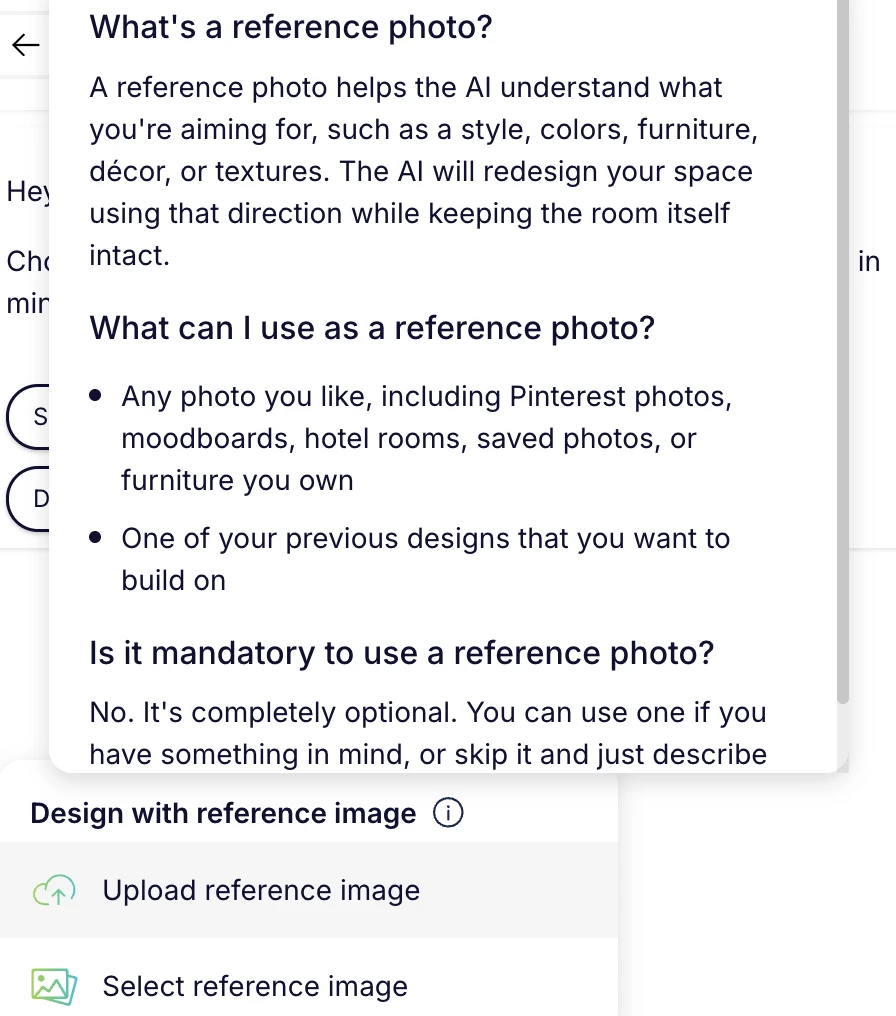
ReimagineHome reference photo guide showing how users can use inspiration images to direct style, color, furniture, and texture
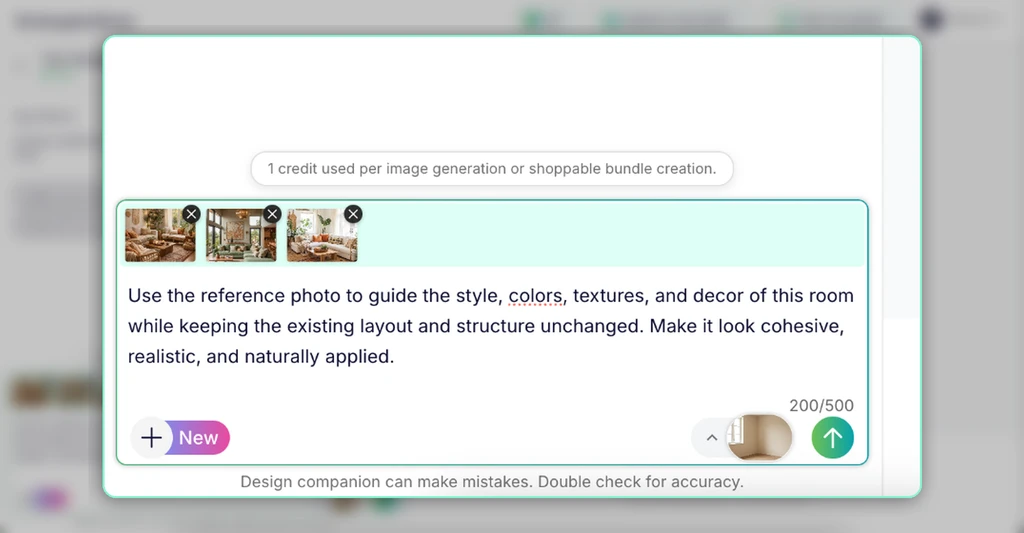
When deciding between a reference image and a text prompt in AI home design, reference images typically yield results more aligned with the desired visual style, while text prompts give users granular control over instructions and constraints. The optimal workflow often combines both: use a reference image to set the aesthetic direction and a text prompt to specify must-keep items, layout changes, or functional needs. This dual approach is central to modern AI visualization platforms such as ReimagineHome.
The distinction matters because images communicate style, palette, and mood more efficiently than words, but prompts allow users to articulate rules the AI should not overlook. Clarifying when and how to use each input method is essential for achieving personalized interior design outcomes that balance vision with practicality.
-
Core Principle: What Reference Images and Text Prompts Do Differently
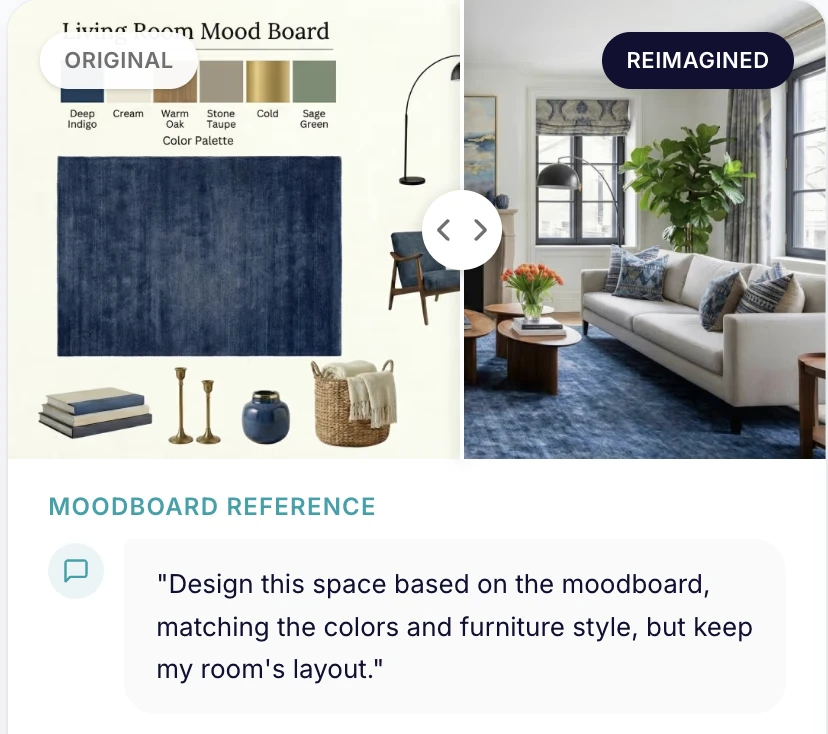
Before, reference, and after composition showing how three inspiration images guided the redesign of an empty spare room into a cozy boho-inspired space.
Reference images and text prompts address separate needs in the AI home design process. A reference image visually communicates nuanced preferences, such as material finishes, color proportions, or atmospheres that are difficult to describe with words alone.
Meanwhile, text prompts are effective for stating explicit requests—such as leaving existing furniture untouched, specifying functional requirements, or restricting changes to a single zone. In this respect, prompts bring order and control, while reference images deliver inspiration and stylistic precision.
These input types are not mutually exclusive; their effectiveness depends on the type of transformation the user seeks. As we explored in our guide to picking paint colors using room photos, AI design tools are most powerful when provided with clear visual cues and supporting context.
-
Mechanism: Why Visual Inputs Lead to Stronger Style Matching
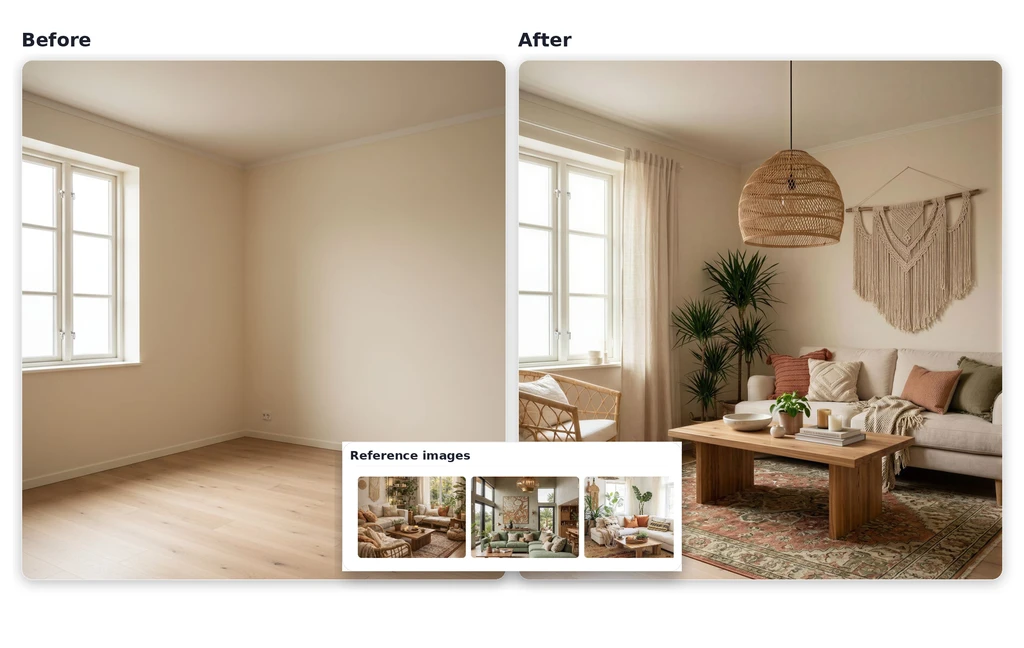
Before-and-after redesign of an empty spare room into a cozy boho-inspired sitting area with layered textures and soft natural light.
The mechanism behind superior results with reference images is rooted in how AI interprets visual data. Images provide direct access to elements of color balance, texture, light orientation, and proportion within a single snapshot, enabling the algorithm to transfer and adapt those qualities into the user’s space with fewer perception errors.
Text prompts, by contrast, rely on natural language processing, which can struggle to precisely interpret vague or subjective instructions. For example, the phrase “warm and cozy” will produce differing results depending on the AI’s internal definitions and training data. If the user supplies an image showing exactly what ‘cozy’ means in context, ambiguity is reduced.
This explains why reference images are particularly effective for ensuring the outcome stays close to the intended visual target, as highlighted in our breakdown of AI mood board upgrades.
-
Practical Application: Combining Text and Image for Best Results
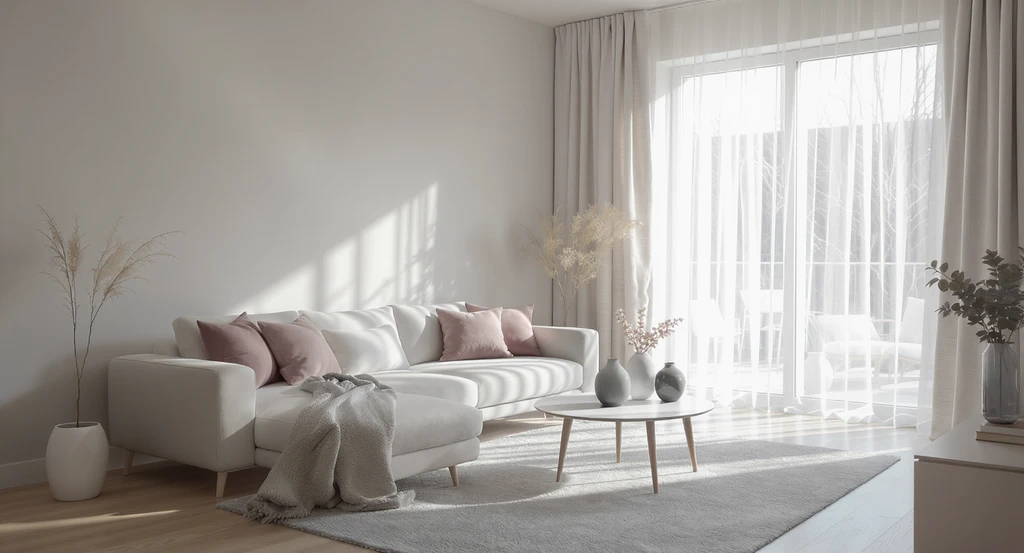
Soft, light-filled living room design with a white sectional, layered neutrals, and an airy minimalist feel.
The safest way to achieve both visual alignment and practical function in AI design is to combine a reference image with a well-crafted text prompt. Use the reference image to set the overarching mood, palette, and inspiration, then specify essential requirements—such as keeping a window clear, adding storage, or limiting style changes to particular features—in the prompt.
For example, uploading a minimalist bedroom image while instructing the AI “retain the current wardrobe and do not cover the skylight” will guide the system to balance stylistic transformation with user-imposed constraints. This approach sharply reduces mismatches between user intent and the output.
This workflow is especially valuable for users personalizing spaces in small apartments, where functional decisions and aesthetic goals often intersect, as detailed in our review of AI tools for compact homes.
-
Constraints and Trade-Offs: When to Prioritize One Over the Other
The primary constraint when using only reference images is reduced specificity: the AI may replicate style accurately but may not respect unique constraints, such as room function, obstructions, or particular items to retain. Conversely, heavy reliance on text prompts risks generic or less visually coherent outputs, as the AI extrapolates style without a concrete visual target.
A critical trade-off emerges: prioritizing a reference image enhances stylistic fidelity but can miss functional requirements, while prioritizing a text prompt secures constraints but may dilute aesthetic impact. This clarifies why merging both methods is optimal for most complex home design goals.
Psychologically, combining both strategies minimizes regret and makes users more confident in their decisions. Visualizing a space before changes—especially in one’s actual room—helps avoid common biases and misperceptions inherent in abstract planning. As discussed in our examination of personalized AI style tools, clear previews ease decision paralysis and increase satisfaction.
Frequently Asked Questions
-
When should I use only a text prompt for AI room design?
- Use only a text prompt when you need the AI to follow detailed instructions, such as preserving existing features, adding functional elements, or making specific and limited changes to your space.
- Yes, REimagineHome allows users to upload up to 3 reference images at once, making it easier to guide the design using multiple style cues, palettes, or furniture directions.
- If the reference image features furniture or spaces of different scales than your room, the AI may adapt styles incorrectly. For best accuracy, choose images with similar room sizes, ceiling heights, and furniture proportions to your own.
- Yes, but spatial constraints are more pronounced in smaller rooms, making it even more important to pair visual references with clear instructions for optimal layouts and function.
Can I upload multiple reference images for a single makeover?
How does scale and proportion affect results when using a reference image?
Do these principles apply to both small and large spaces?
Key Takeaways: Optimizing AI Design Inputs
Reference images are best for defining visual style, while text prompts clarify constraints and functional needs. Combining both input types in AI home design platforms such as REimagineHome consistently produces results that are visually on-target and tailored to user requirements. Select each input based on whether you need style clarity, design control, or both for your next room makeover.