Rethinking Undercabinet Lighting: Halogen vs LED in 2026
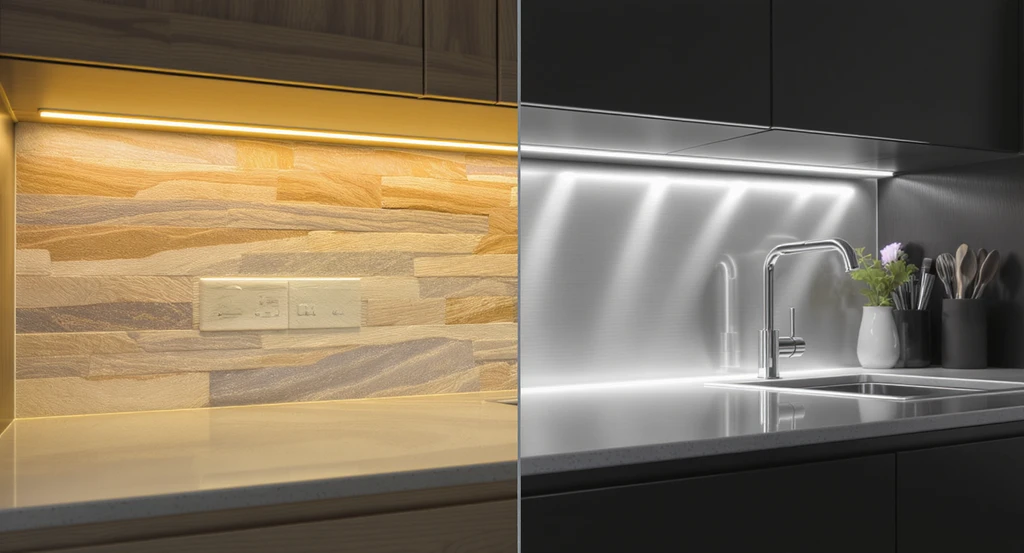
TL;DR
Choosing undercabinet lighting isn’t about trends it’s about matching the light’s effect to how your kitchen feels and works. Halogen promises warmth and color, but introduces heat, bulk, and short lifespan. High-quality LED strips now rival halogen for color accuracy and flexibility, with far fewer hidden drawbacks.
Why the Choice Still Matters in 2026
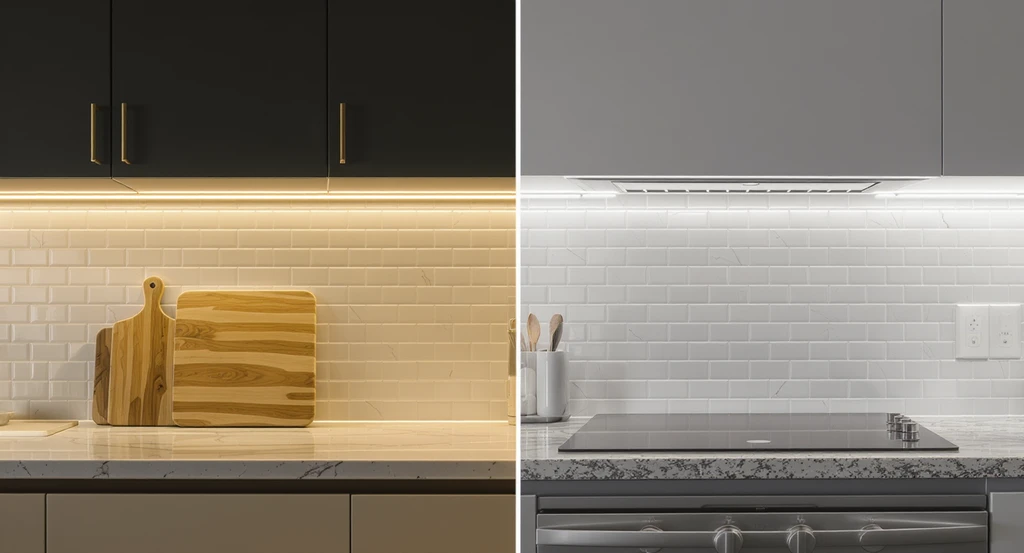
A side-by-side look at halogen vs LED undercabinet lighting in a modern kitchen shows real differences in warmth, color rendering, and ambiance.
Lighting under your kitchen cabinets does more than brighten a counter. It changes how your surfaces look, how food appears, and even how the space feels late at night. For those sensitive to the subtle difference in glow, warmth, and color rendering, the debate between halogen and LED is far from settled despite much of the market having moved on to LED by default. Beneath the surface, this decision isn’t just technological. It’s about emotional clarity: Why does one light source make your kitchen feel “right,” and another leave things flat or harsh? Do new LEDs really match the famed softness and color accuracy of halogen, or is something lost that you only notice when the lights are on? This article will help you see the true trade-offs and bring language to hesitations you might not have put your finger on.
-
What’s Actually Happening Under the Cabinets
A side-by-side view of halogen and LED undercabinet lighting reveals differences in warmth, shadow softness, and how each interacts with kitchen surfaces.
Beyond color quality and warmth, brightness levels matter just as much. According to recommendations from the Illuminating Engineering Society (IES), kitchen task areas such as countertops used for food preparation should typically receive between 300–500 lux (30–50 foot-candles) of illumination. Many undercabinet setups whether halogen or LED fall short or overshoot this range depending on strip density, mounting height, and diffuser choice. Evaluating light output against these benchmarks ensures your lighting is not just aesthetically pleasing, but functionally appropriate for safe and comfortable meal preparation.
-
Why Halogen Fixtures Still Have Emotional Appeal
For many, halogen lighting is less about nostalgia and more about predictability and emotional satisfaction. The light feels “real”—not just in temperature but in how it gently fills the area, without making whites look blue or reds look dull. When you’re chopping tomatoes or plating a meal, this subtle fidelity can encourage a sense of ease. There’s also the psychological comfort of knowing when the bulb will fail (it dims and blackens, not just shuts off), and the reassurance that the fixture will stay serviceable for years. However, this comes with a trade-off: visible bulk under the cabinets, added heat in summer, and an energy inefficiency that is now impossible to ignore in well-insulated homes.
-
What Most People Assume About LEDs—And What They Miss
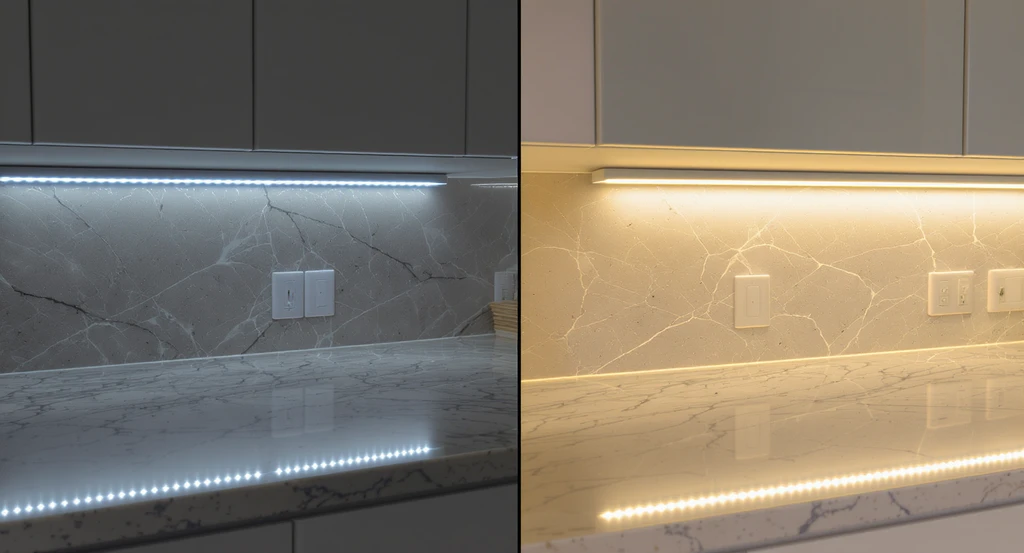
Comparing basic exposed LED strips and high-CRI, diffused LED lighting highlights how installation methods and advanced technology impact undercabinet lighting quality.
LED skepticism often comes from early experiences with flicker, poor color accuracy, or harsh blue tones. Yet, not all LEDs are created equal. Advanced options from brands like Waveform, Yuji, and Flexfire now offer CRI ratings above 95 with high R9, true 2700K output, dim-to-warm features, and flicker-free drivers. Most homeowners underestimate how much the installation method impacts LED light quality. Exposed strips can cause glare and highlight countertop imperfections, while mounting in an aluminum channel with a diffuser gives a softer edge, closer to the ambient wash of halogen. Choosing a power supply and dimmer suited to the strips (such as ELV or TRIAC-compatible drivers) also ensures true low-end dimming—a detail that makes a kitchen glow at midnight, not blast with excess light.
-
Where the Real Trade-Offs Lie: Heat, Thickness, and Longevity
The measurable differences are clear. Halogen fixtures, even the slimmest 12V G4 models, still require more vertical space and can reach surface temperatures over 150°F/65°C. This not only rules out some installations (close to wood or plastic) but can damage finishes and warm stored food unintentionally. Halogen bulbs typically last 2,000–4,000 hours, compared to 25,000–50,000 hours for good LEDs. The bulk and necessary electrical clearance mean true “invisible” undercabinet lighting is rarely possible with halogen. LED strips, on the other hand, can be recessed into routed cabinet channels (as narrow as 10mm with a diffuser), producing an unbroken line of light subtle, unobtrusive, and often indistinguishable during daytime. The key limitation: not all LED strips are field-serviceable, so replacing a failed length may require partial reinstallation. However, models with modular connectors and readily available drivers reduce this risk. The upfront cost for quality LED is higher, but replacement and running costs are much lower.
-
Seeing the Subtle: Why Visualization Prevents Regret
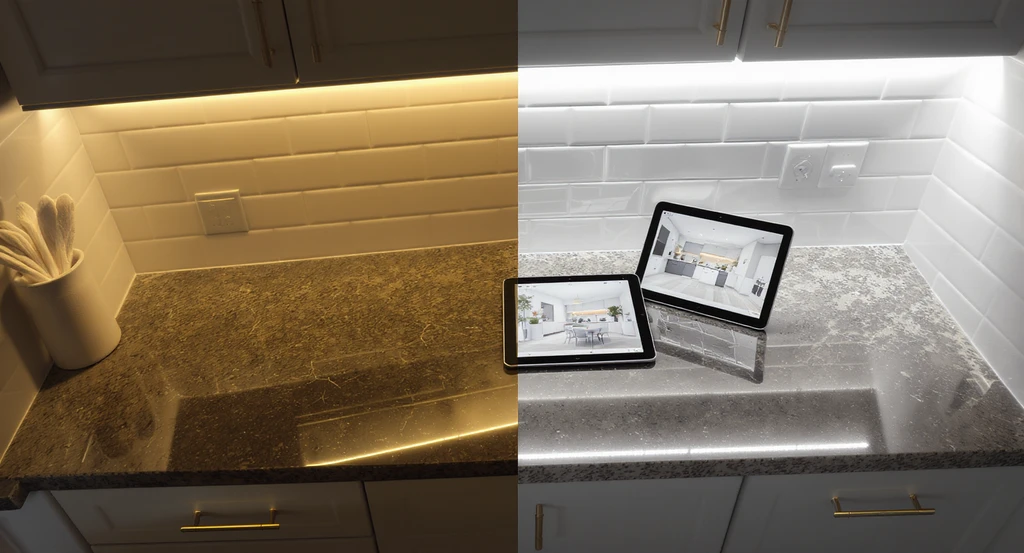
Accurately visualizing kitchen lighting—showing differences between warm halogen and cool high-CRI LED on brass hardware—prevents regret in fixture selection.
Most lighting disappointment comes from not knowing how a fixture will engage with the surfaces and sightlines in your kitchen. Light’s effect is context-dependent: brass hardware will look entirely different beneath a warm halogen than under an ultra-cool, high-CRI LED. A recessed LED strip with proper diffusion can evoke the same softness as a classic halogen bar—but only if planned with the specific finishes and shapes in your actual space. Visualization with tools like REimagineHome AI offers the ability to preview not just color but the physical weight and shadow interplay of a proposed fixture. This eliminates the common regret of “why does it feel harsher/dimmer/brighter than I imagined?” It also helps identify if a fixture’s heat, bulk, or cable routing might clash with your workflow or layout in ways not obvious from a product photo or spec sheet.
-
Grounded Adjustments: Making the Best of Either Option
If halogen feels non-negotiable for you, prioritize minimal-profile 12V G4 fixtures mounted inside a custom valance, paired with a deep recess in the cabinet bottom to hide visible bulk. Add a heat shield behind the light and keep combustible materials away from the fixture. For LEDs, seek out 24V high-CRI strips (with R9 ≥ 90), install in a routed aluminum channel, and use a high-quality, flicker-free dimmable driver. Match the diffuser’s opacity to your countertop material for glare management. Plan junction points in alignment with task zones, not just wiring convenience. In both scenarios, physically test a sample length in place before committing. Stand at your main prep area at night; if the light causes you to squint, pick up odd shadows, or makes your favorite dish look off, keep iterating until it’s right.
Visualization Scenario
You stand in your kitchen at dusk. Instead of guessing how different fixtures might affect the warmth of your white tile or reveal the gloss on your counters, you use a visualization tool to project various lighting options onto a live photo of your space. In seconds, you can compare a classic halogen glow versus a high-CRI LED strip and see precisely how the light interacts with your finishes making your decision grounded and regret-free.
Undercabinet Lighting: Questions Answered
While not common, some specialty suppliers offer halogen fixtures and bulbs for undercabinet use. Options are limited and may require custom installation.
How do I achieve 'halogen-like' warmth with LEDs?
Choose high-CRI (95+) LEDs with a true 2700K rating and high R9 value. Pair with a quality diffuser and flicker-free driver for natural-looking light.
Do halogen undercabinet fixtures increase kitchen heat?
Yes. Even slim halogen fixtures produce significant heat, which can warm the underside of cabinets and affect stored items above.
Can LED strips be recessed for a hidden look?
Yes. Modern LED strips, with compatible aluminum channels, can be recessed into routed cabinet grooves, creating a low-profile and uniform light source.
Clarity Over Habit: Choosing the Light Your Kitchen Deserves
Good undercabinet lighting is not about nostalgia versus novelty it’s about aligning light’s properties with how your space works and feels. Halogen still offers unique visual warmth but comes with drawbacks in heat, size, and efficiency. Modern LEDs can now match or exceed its color accuracy if chosen carefully, with greater flexibility and subtlety in presentation. Whichever you choose, previewing the effect in your real kitchen context, not just by technical specs, yields the most satisfying and lasting result.