7 Patio vs Deck Value Factors Every Homeowner Should Evaluate Before Remodeling
TL;DR
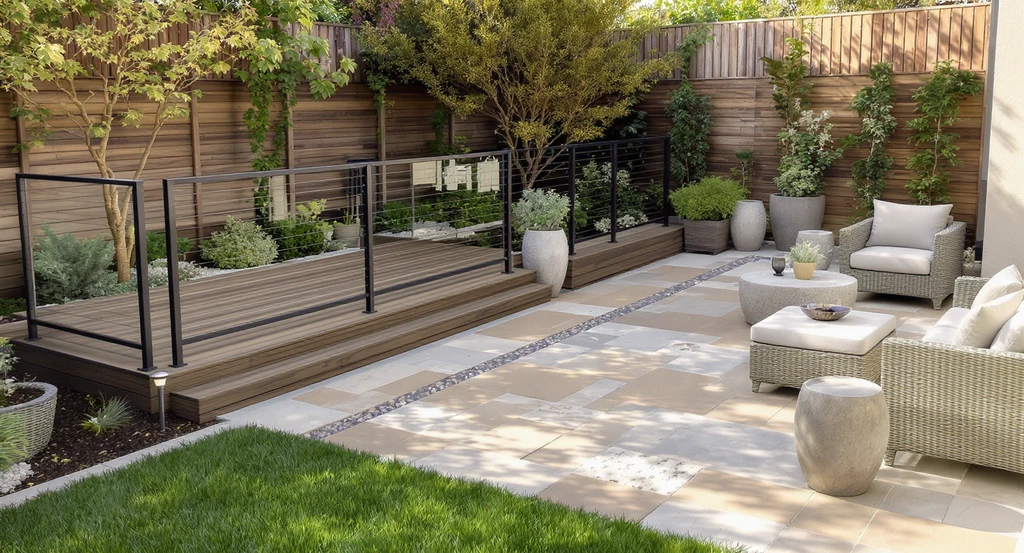
Choosing between a patio and a deck requires more than personal preference. Key differences in site suitability, cost, maintenance, privacy, climate impact, long-term usability, and resale should inform your decision. Using a structured evaluation method and visualization tools, you can reduce uncertainty and improve the satisfaction and value of your outdoor investment.
Introduction: Navigating the Patio vs Deck Dilemma
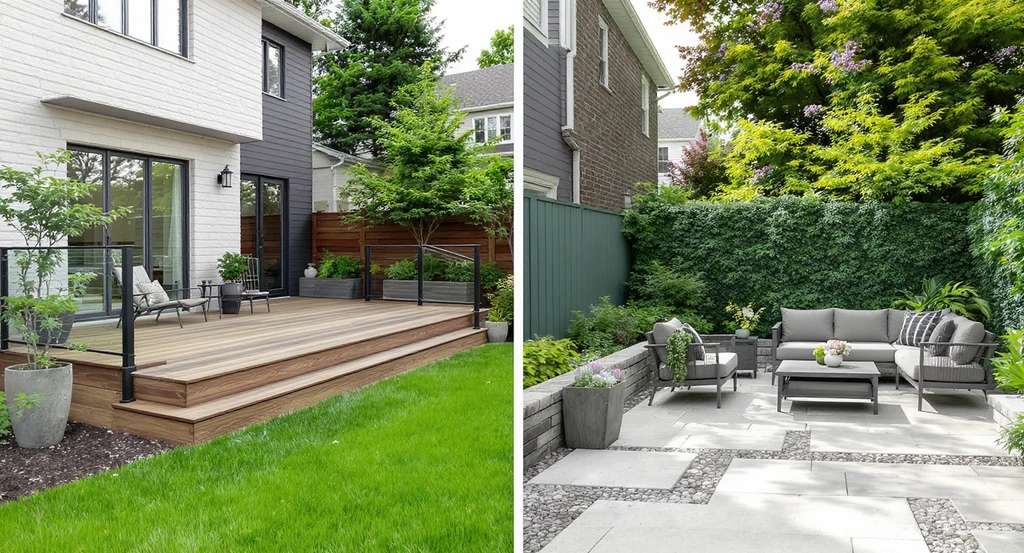
Comparing patio vs deck for backyard value: view a composite deck and a paver-stamped concrete patio side by side, revealing the best low maintenance patio materials, how to increase backyard privacy, and pros and cons for outdoor living spaces.
When considering a major outdoor upgrade, homeowners often question whether a patio or a deck adds more value—functionally and financially—to their backyard. The discussions range from up-front costs and maintenance headaches to resale ROI, with significant anxiety around committing to the right solution. While community opinions reveal nuanced trade-offs, structured evaluation matters most when long-term enjoyment and investment outcomes are at stake. This guide organizes the decision-making process into clear, evidence-based steps. Using the Outdoor Living Value Assessment Logic, each factor is tackled with measurable rules and non-obvious spatial insights, so you can visualize, compare, and commit with confidence.
-
01. Site Elevation and Yard Integration Dictate Feasibility
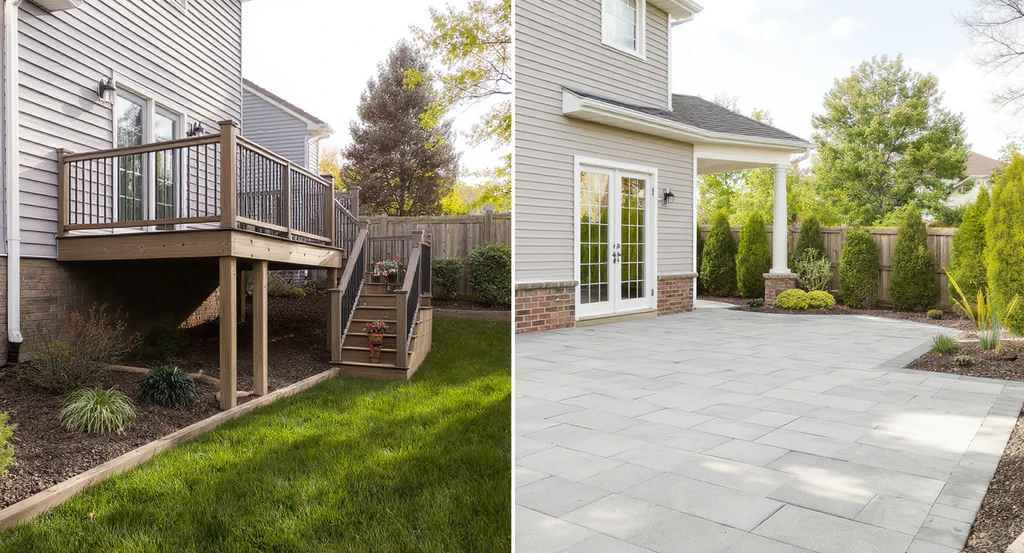
Site elevation shapes patio vs deck for backyard value—raised decks bridge grade changes, while low maintenance paver patios boost return on investment on level yards. See pavers vs stamped concrete pros and cons in seamless yard integration and how to increase backyard privacy with landscaping.
Choose a deck for substantial elevation changes or a patio when the yard is level with the home’s threshold. Decks excel when bridging grade differences, providing function where walk-out access isn't possible, whereas patios connect seamlessly to flat yards and foster a ground-level flow that encourages direct yard engagement. This difference impacts circulation: decks add vertical interest and make uneven lots usable, but may impose extra steps or railings that restrict movement and increase construction complexity. Patios on flat sites allow for broader gathering areas, unobstructed by safety codes or multi-riser stairs, and can make entry points less visually prominent. Many assume a deck is always the default for a modern yard, but actual use and comfort stem from how well the structure matches the site’s grade transitions. According to our advice on proper planning for stable patios, groundwork and layout must be tailored to your specific terrain to prevent post-build regret.
-
02. Upfront and Lifetime Costs Depend on Material and Design Choices
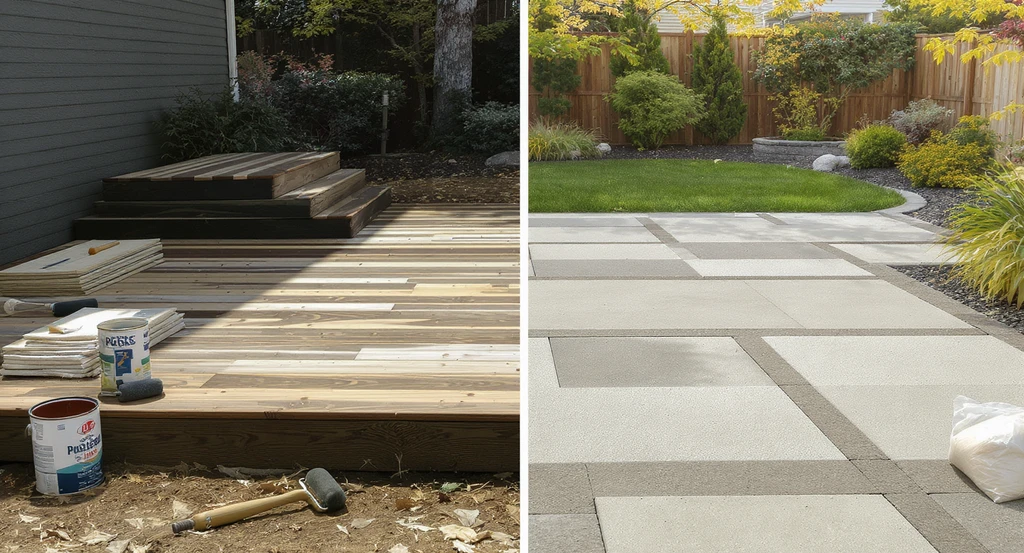
This visual comparison of a wood deck with maintenance tools and a low-maintenance paver patio spotlights patio vs deck for backyard value and upfront versus lifetime costs, aiding value-driven outdoor living space choices.
Initial installation costs for decks typically exceed patios, especially as lumber or composite prices rise. Conversely, patios (especially with pavers or stamped concrete) become relatively more appealing when material costs fluctuate, as detailed in our guide to paver patio building. However, lifetime maintenance costs complicate the picture. Decks often require periodic staining, structural inspections, or board replacement, while patios may demand joint stabilization and weed control but less frequent intensive upkeep. The measurable rule: expect to restain a wood deck every 2–4 years, while paver patios may only need sand replenishment every 5 years—a decisive difference in ongoing labor. Many expect the cost comparison ends once installation is complete, but long-term expenses can equal or even surpass up-front differences, especially in harsh climates.
-
03. Maintenance Intensity Varies by Surface and Junctions
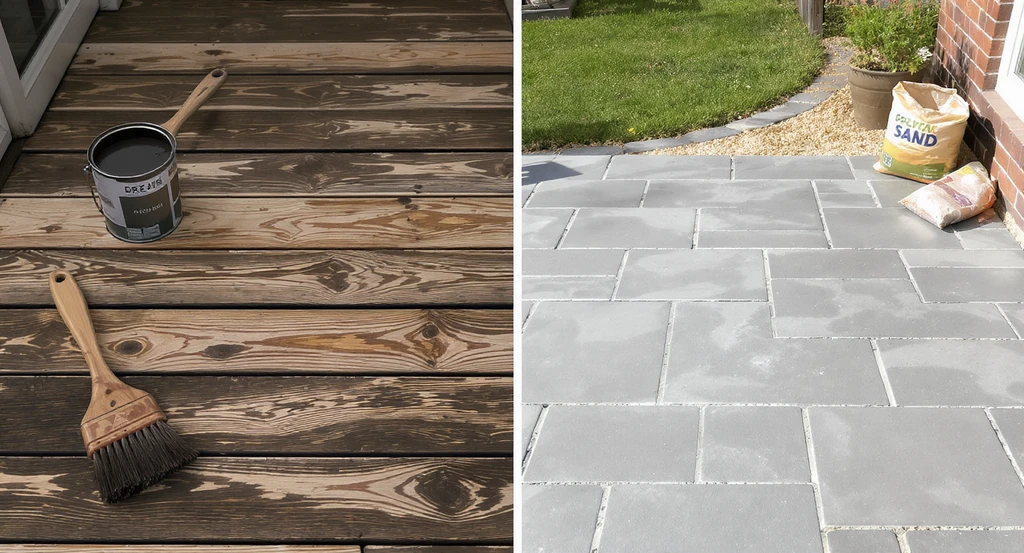
Comparing patio vs deck for backyard value: a weathered wood deck with stain supplies beside a sealed, weed-free paver patio using best low maintenance patio materials. Correct joint and surface care maximize return on investment for outdoor living spaces and demonstrate pavers vs stamped concrete pros and cons.
Decks require consistent surface care—staining, sealing, and hardware checks—to prevent rot, splintering, and structural deterioration. Patios, particularly those constructed with pavers, primarily contend with weed growth and settling. A non-obvious maintenance insight: patios with polymeric sand joints and sealed surfaces experience markedly fewer weed outbreaks and edge failures, as explored in our proven paver maintenance strategies. This reduces the most dreaded patio chore—weed pulling—which often emerges years after the initial install if shortcuts were taken in the base prep phase. Many homeowners underestimate the source of future trouble, assuming decks are only high maintenance due to exposure. In reality, correct joint treatment is just as important as surface choice for patios, with less frequent but inevitable re-leveling required over decades.
-
04. Visual Privacy and Wind Protection Are Easier to Achieve With Ground-Level Patios
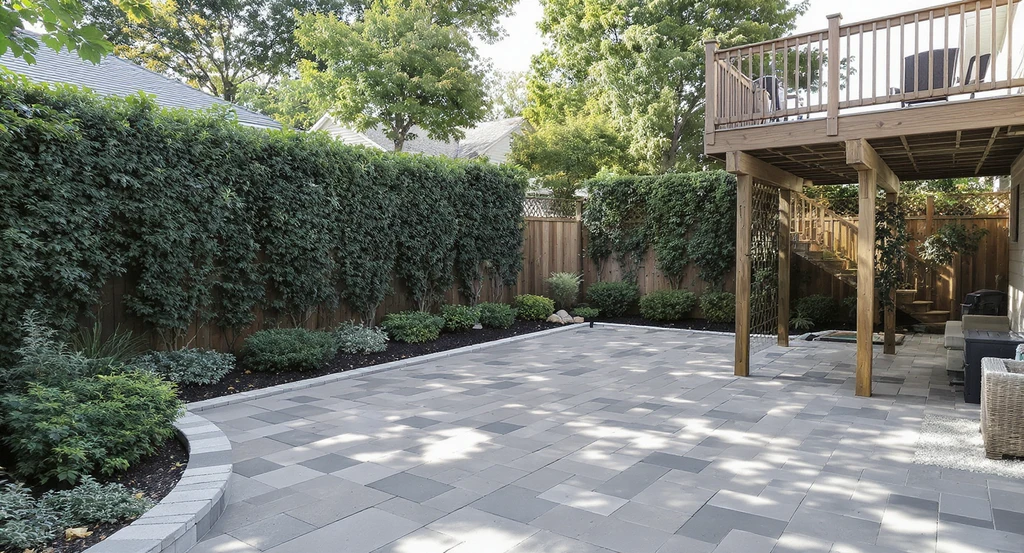
A paver patio enclosed by plantings, fences, and trellises demonstrates how patios offer better privacy and wind protection compared to raised decks. This shows patio vs deck for backyard value and highlights the impact of low maintenance patio materials, privacy strategies, and landscape integration.
Patios provide superior privacy and shelter from wind by leveraging fences, plantings, or screens positioned at human scale, especially in close suburban neighborhoods. Decks by contrast place users in a more visible, elevated position, limiting the effectiveness of typical privacy solutions and sometimes exacerbating wind exposure. A spatial reasoning method here is to map sightlines and local wind patterns before choosing; patios allow for layered privacy with trellises, hedges, or perimeter plantings, while decks require higher—sometimes regulated—railing or screening that may not match landscape maturity. A common misconception is that decks always increase usable entertaining space, but they can unintentionally make outdoor living feel exposed. After visualizing both options, many homeowners report patios feel more "enveloped," supporting relaxed use without feeling on display. This becomes strikingly clear in visual previews where privacy barriers, step-back distances, and plant massings can be tested before building.
-
05. Climate Influences Long-Term Performance and Comfort
Material selection must account for climate, especially in regions prone to freeze/thaw cycles, moisture, or intense sun. Wood decks in damp or sunny climates suffer more rapid weathering, while concrete patios risk cracking unless installed with uncompromising base prep. The measurable rule-of-thumb: In cold climates, paver patios with proper gravel base and drainage perform best, requiring at least 6–8 inches of compacted stone beneath to avoid heaving, as confirmed in our walkthrough on cold-climate patio installation. Stamped concrete, while attractive, is susceptible to surface damage and de-icing restrictions, impacting long-term usability. "Surface damage occurs when poorly installed concrete or paver patios encounter repeated freeze/thaw cycles. It changes both safety and appearance, often leading to costly repairs or reduced use. Most homeowners assume any surface can handle their climate, but in practice durability depends on proper substrate depth and drainage design—making early diligence essential."
-
06. Resale Value Is Context Sensitive—Not a Simple Deck vs Patio Calculation
There is no universal winner: the return on investment for outdoor living spaces is deeply influenced by neighborhood norms, local climate, and prevailing material quality. In most markets, functional updates yield a 35–60% ROI, with premium or highly personalized features sometimes yielding less, as explained in our discussion of landscaping ROI and hardscaping value. A key spatial insight: decks that increase perceived square footage adjacent to main living areas can attract buyers, particularly on sloped lots, while patios integrated with lush gardens can boost both curb appeal and perceived privacy—a factor that is sometimes more valuable to buyers than raw square footage. Many believe a deck always boosts resale more than a patio, but market data shows that usability, maintenance history, and visual appeal outweigh blanket assumptions about structure type. Visualizations of both scenarios, using platforms like ReimagineHome, let homeowners assess which addition aligns with buyer psychology in their local market before committing funds.
-
07. Visual Validation Reduces Uncertainty and Accelerates Commitment
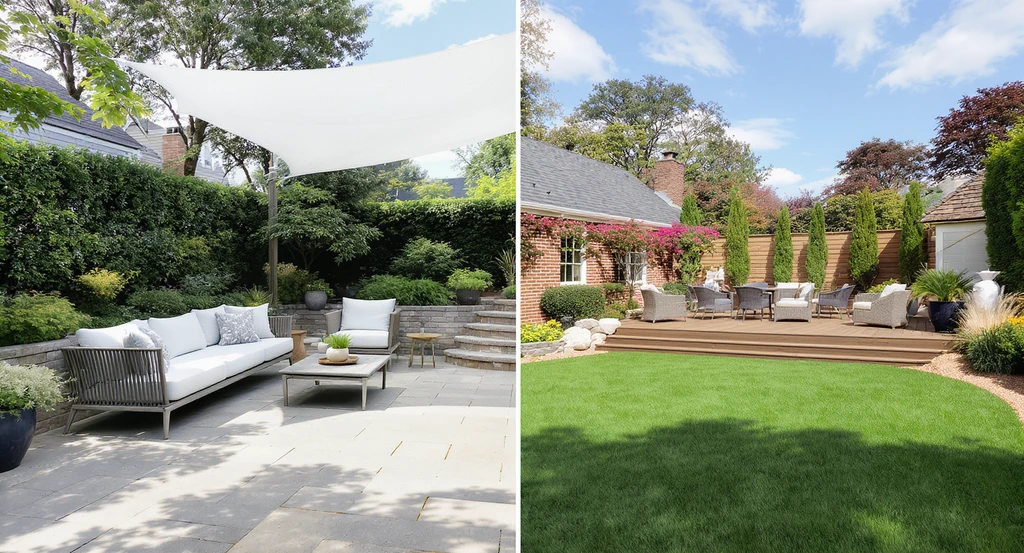
Visual validation tools compare patio vs deck for backyard value, highlighting best low maintenance patio materials and solutions for how to increase backyard privacy, while previewing return on investment for outdoor living spaces and the pavers vs stamped concrete pros and cons in an actual yard.
Uncertainty in outdoor remodels shows up as hesitation over layout, privacy, shade, and the perceived impact of new hardscapes on existing features. Before visualization, homeowners often struggle to picture how circulation, sightlines, and wind protection will change—leading to analysis paralysis. With realistic previews using digital or augmented approaches, you can test step placements, furniture scales, screening effects, and even material reflectivity. This supports faster progress to purchase by lowering the probability of regret: you see step shadows, wind protection, and privacy changes in context—not in isolation. Visual validation turns abstract choices into concrete scenarios, as seen when tools like ReimagineHome are deployed to simulate both deck and patio options in your actual yard. This decision structure helps convert uncertainty into action-readiness, supporting better outcomes and fewer surprises at every stage.
Frequently Asked Patio vs Deck Questions
Which delivers higher resale value—a deck or a patio?
A deck may boost perceived living space in some regions, especially when attached to main-floor living areas. Patios tend to appeal more in regions where ground-level outdoor living is the norm. Resale value depends more on quality, context, and maintenance than structure type.
Are paver patios really low maintenance compared to decks?
Paver patios with stabilized sand and effective edging require less frequent and less intensive upkeep than wood decks, which need regular sealing. Maintenance does exist for both; choosing high-quality materials and proper installation is critical.
Does climate make stamped concrete or wood decks a poor choice?
Yes, harsh freeze/thaw cycles can crack concrete, and heavy rainfall or sun exposure can shorten wood deck lifespans. Material selection must always reflect local climate and exposure for long-term performance.
How important is visualization before deciding between patio and deck?
Seeing your plan in a realistic preview addresses layout, shading, privacy, and access concerns, making it easier to commit confidently and avoid post-build regret.