Does Your Coffee Table Work From Every Seat?

TL;DR
Check your coffee table from every sofa position and chair, not just the centre seat. Test reach, usable surface, table height and the space needed to stand and leave. A distant chair may need a side table rather than a larger coffee table. Compare alternatives in Chez by ReimagineHome, then verify the preferred arrangement in your actual room.
-
1. Start With the Seat That Struggles

A well-balanced coffee table should work for the sofa and surrounding chairs without crowding circulation. Test reach, usable surface, table height, and movement from every seat before changing the layout.
Instead of asking whether your coffee table looks centred, ask: “Where does someone struggle to put down a drink?” Start with that position, whether it is an armchair, a sofa end or a sectional corner. Choose the activity you are trying to improve. Drinks can use separate surfaces; a board game requires access to the same playing area.
Keep the main walking route as a constraint while exploring changes. ReimagineHome’s guide to restoring living room flow discusses why a central table’s position should be reconsidered when it interferes with movement.
-
2. Check Reach, Height and Movement Separately
Treat access to a surface and movement around it as separate questions. ReimagineHome’s comfort and accessibility guide identifies both reach and circulation as important considerations. Use the checklist below as a practical household test, not an accessibility assessment.
Check What to test from each seat Comfortable reach Sit normally with your usual cushions. Place and retrieve an empty cup without an uncomfortable stretch or twist. Table height Check whether using the surface requires an awkward bend or lift. Test from both the sofa and armchairs. Usable surface Find a clear, stable area that supports the whole cup base, not merely a reachable edge. Standing and leaving Stand and exit while neighbouring seats are occupied. Check knees, feet, projecting legs and corners. Moving furniture Check swivel chairs, recliners and nesting tables in their normal operating positions, following product instructions. Record Works, Needs change or Not tested for each seat and check. Involve the people who regularly use the room. A measured furniture gap is not proof of comfortable reach.
-
3. Create Your Living Room Comparison in Chez
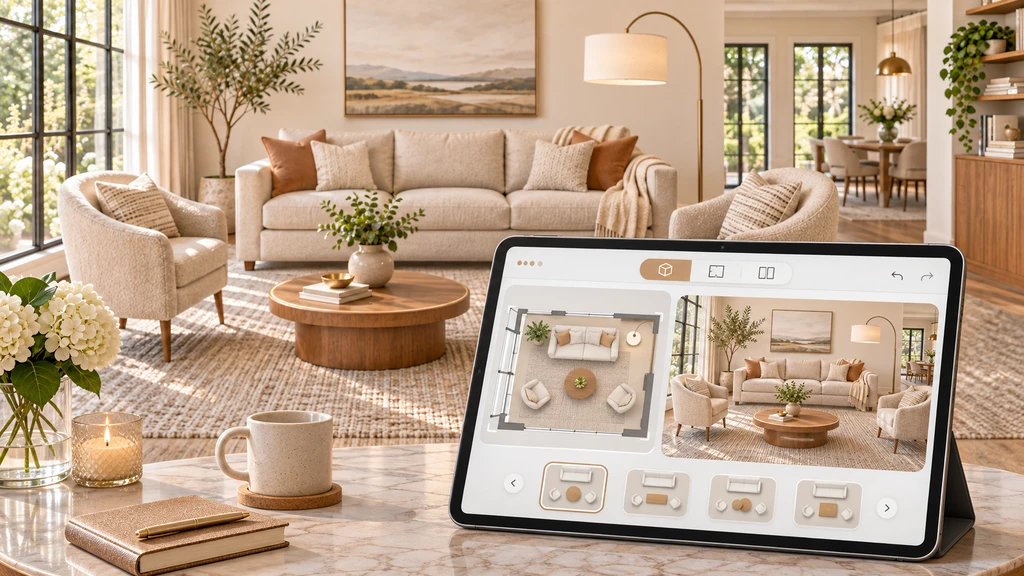
Use a 3D room comparison to test how the coffee table relates to every seat, then compare spacing, reach, and circulation before making changes in the real room.
Chez by ReimagineHome turns room photographs into an explorable 3D space. Upload at least two clear photographs of the same room; four to eight overlapping views are recommended. You can review the room through its floor plan and 3D walkthrough.
Use available catalogue furniture to approximate your current arrangement, rather than expecting your exact furniture to be reproduced automatically. Keep seating positions consistent while comparing one table change. Treat models with different dimensions as conceptual stand-ins, not proof of fit. Follow the Chez room-planning guide to get started.
-
4. Compare the Layout From Four Useful Views
Review the current arrangement and one alternative from the same viewpoints. The aim is to identify spatial questions worth testing physically, not to judge comfort from a single attractive image.
View Question to investigate Floor plan Does the table’s footprint interfere with the route around the seating group? Near the sofa end How does the table relate to the end seat compared with the middle position? Near the armchair Could a separate surface serve this seat without crowding its exit? Entrance view Does the revised arrangement obstruct the approach to the seating area? Chez’s dimensions are estimates derived from photographs, and unseen areas are inferred. Check the reconstructed room against reality before relying on the comparison. A virtual viewpoint does not measure an individual’s seated reach.
-
5. Fix the Failed Check Before Buying a Bigger Table
Consider a hypothetical five-seat arrangement: three sofa positions and two armchairs share one coffee table. The sofa users can set down drinks comfortably, but one armchair user cannot. Compare a small table repositioning first. Then compare keeping the coffee table where it is and placing a suitable side table beside that chair.
Evaluate what each change improves and what it makes worse. Moving the coffee table might help the armchair but disadvantage the opposite sofa seat. A side table might serve drinks but leave the shared-game problem unresolved. Choose the alternative that addresses the activity, not simply the one that fills the gap.
-
6. Confirm the Arrangement in the Real Room
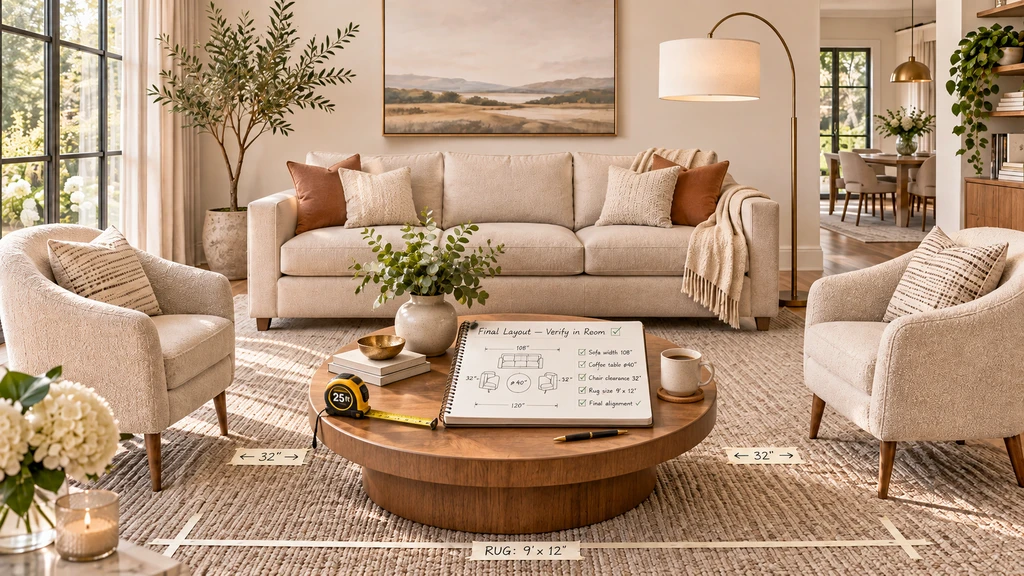
Confirm the final coffee table arrangement with real measurements. Check chair clearance, table position, rug size, and circulation before deciding that the layout works for every seat.
Before ordering furniture, check the actual product dimensions and mark its footprint using a surface-safe method. Include projecting legs or bases. A floor outline helps you examine placement, but it does not test table height, stability or seated reach. Repeat the relevant checks with real furniture or a suitable showroom trial where practical.
Choose the change that resolves the original problem without creating another. Leave anything untested clearly recorded rather than assuming the preview has confirmed it. For the digital comparison, use the step-by-step guide to creating and exploring your room in Chez.
Frequently Asked Questions
Does every seat need to reach the coffee table?
No. For most daily use, a side table can serve chairs or distant seats. If playing a game or serving snacks, test access to the main surface itself for everyone.
Can a 3D room preview confirm comfortable reach?
Not exactly. A 3D room model lets you compare spacing, arrangement, and sightlines. Physical factors—like individual reach or table stability—need to be checked at home.
What if only one chair struggles?
Fix the tough spot (with a side table or different placement) rather than increasing the coffee table size for the whole room.
Takeaway: Rethink Before You Rearrange or Replace
Testing coffee table placement seat by seat, and exploring options in 3D, lets you solve actual accessibility or flow issues for your household. Fix the true problem before chasing a bigger table or trendier shape. Join the waitlist to see how Photos to 3D will help you virtually walk your own living room and make smarter, comfort-driven design choices.